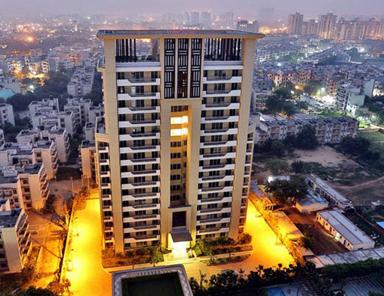
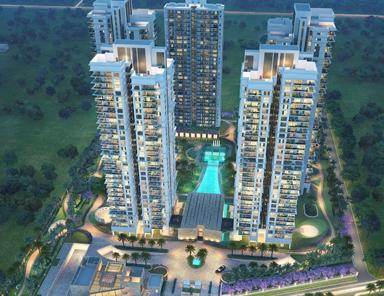
If you live in Dubai, London or San Francisco and you have been tracking Gurgaon for an India investment, Tonino Lamborghini Residences in Sector 71 Gurgaon is probably already on your shortlist. It is the first Lamborghini-branded address in India. 812 units. 12.4 acres on the SPR. Signature Global is the developer. Starting price post-launch is ₹5.30 Cr.
This guide is the answer to one question we keep getting from NRI clients: what does it actually take to book this project without flying to India? Below is the full process. FEMA rules, payment routes, Power of Attorney, home loan options, taxes, and what happens when you eventually sell. Every figure here is checked against 2026 RBI and Income Tax positions, not the older numbers floating around on broker sites.
Why this project fits the NRI buyer profile
Three reasons it works.
First, the brand. Tonino Lamborghini is a globally licensed lifestyle brand, so the address reads the same way in Dubai or Manhattan as it does in Gurgaon. You will not have to explain what you bought.
Second, the ticket. ₹5.30 Cr is roughly USD 635K, AED 2.33M or GBP 500K at May 2026 rates. That sits inside the range most UAE and US NRIs allocate to a single Indian property, especially if you already own something in Dubai or New York.
Third, the timeline. Possession is scheduled for 2030, and the project sits on Sector 71 on the SPR corridor The construction-linked payment plan lets you stagger remittances across multiple financial years, which makes both the USD 1 million annual repatriation cap and your home-country tax planning a lot easier to manage.
If you are still comparing options across the corridor, our analysis on how it stacks up against Birla Pravaah and Godrej Samaris covers the trade-offs in detail.
Can NRIs and OCIs legally buy this project?
Yes. And no, you do not need RBI approval.
Under the Foreign Exchange Management Act, 1999, and the Foreign Exchange Management (Non-Debt Instruments) Rules, 2019, both NRIs and OCI cardholders can buy residential property in India under what is called the general permission route. No special clearance. No application to the RBI.
Three things to know.
- There is no cap on how many residential properties an NRI or OCI can own in India. One, five, ten. All allowed.
- Some property types are off-limits. Agricultural land, plantation property and farmhouses cannot be purchased by an NRI or OCI. They can be inherited or received as a gift from a resident Indian, but not bought. Tonino Lamborghini Residences is a residential apartment project on non-agricultural land, so none of this applies here.
- Citizens of 11 specific countries (Pakistan, Bangladesh, Sri Lanka, China, Iran, Afghanistan, Nepal, Bhutan, Hong Kong, Macau, North Korea) do need explicit RBI approval. If you hold an Indian passport or an OCI card, this is not your problem.
HRERA number for the project: RC/REP/HARERA/GGM/1056/788/2026/28. Pull this up on haryanarera.gov.in before you transfer any token money. We tell every NRI client the same thing. It takes two minutes and it is the single best fraud-protection step you can take.
The 7-step booking process
From first enquiry to a signed Agreement of Sale, most NRI bookings on this project close in 21 to 35 days. Here is what each block looks like.
| Step |
What happens |
Timeline |
| 1 |
First enquiry, virtual site walkthrough, EOI of ₹9.9L |
Day 0–3 |
| 2 |
Pick the configuration (3 BHK, 4 BHK or 4.5 BHK), shortlist a unit |
Day 3–7 |
| 3 |
Open or activate your NRE/NRO account if you do not already have one |
Day 5–14 |
| 4 |
Draft and execute a Specific Power of Attorney if you are not flying in |
Day 7–21 |
| 5 |
Home loan sanction, if you are taking one |
Day 10–25 |
| 6 |
Booking amount transfer and Agreement of Sale signing |
Day 21–28 |
| 7 |
Registration at the sub-registrar, in person or via your PoA holder |
Day 28–35 |
The step that always takes longer than people expect is Step 4. Drafting the Power of Attorney, getting it notarised, and then apostilling or attesting it from abroad. UAE buyers can usually get this done in 7 to 10 days through the Indian Consulate in Dubai. US and UK buyers should plan for 14 to 21 days.
How to pay: NRE, NRO, FCNR or direct wire
Under FEMA, every rupee of property payment from an NRI has to flow through proper banking channels. Cash, foreign currency notes, third-party transfers from a relative's non-NRI account, hawala. None of that works. It will invalidate the transaction and bring RBI scrutiny down on you.
Here are the routes that do work.
| Account type |
Where the money comes from |
Repatriation when you eventually sell |
| NRE (Non-Resident External) |
Foreign income remitted into India |
Fully repatriable, both principal and gains |
| NRO (Non-Resident Ordinary) |
India-sourced income such as rent, dividends, inherited funds |
Capped at USD 1 million per financial year |
| FCNR (Foreign Currency Non-Resident) |
Foreign-currency fixed deposits |
Fully repatriable on maturity |
| Direct wire transfer |
Sent from your overseas bank through normal banking channels |
Treated as NRE-sourced for repatriation |
Our advice to every NRI client: route the booking through your NRE account wherever you can, or send a direct wire that lands in NRE. This is the single decision that protects your exit. When you eventually sell, NRE-funded purchases come out without the USD 1 million annual cap. On a ₹5 to 10 Cr asset, that difference is significant.
Home loan options for NRIs
If you want to finance, Indian banks will lend NRIs up to 75 to 85% of the property value on a project like this. As of May 2026, SBI, HDFC, ICICI, Axis and Kotak all have dedicated NRI home-loan desks for ultra-luxury Gurgaon properties.
A few specifics worth knowing.
- LTV usually sits at 75 to 85%, but expect closer to 75% at the higher unit prices.
- Tenure runs 5 to 15 years for NRIs. Resident Indians get up to 30. Plan your EMI math around the shorter window.
- Interest rates are floating, currently in the 8.5 to 9.5% range. NRIs typically pay 25 to 50 basis points more than residents.
- EMIs have to come from your NRE, NRO or FCNR account. You cannot pay EMIs directly from a foreign bank account. Plan the funding flow before you sign.
- You get tax deductions of up to ₹2 lakh on interest (Section 24) and ₹1.5 lakh on principal (Section 80C). You have to file an Indian ITR to claim them.
Three things on the lender side that we have seen trip people up. Some banks cap exposure on a single project, so the sanction queue fills, and you want to be early. Developer-tied loan products often clear in 8 to 10 working days, which is faster than going to a bank cold. And if you add a resident Indian co-applicant (a spouse or parent), you usually get better LTV and tenure.
Power of Attorney: how to book without flying to India
If you cannot get to Gurgaon for the registration, the whole booking can be run by a trusted resident Indian (usually a parent, sibling or spouse) operating under a Specific Power of Attorney.
One thing we keep telling clients: use a Specific PoA, not a General PoA. A Specific PoA narrows the holder's authority to defined acts. Signing the Agreement of Sale, registering the property, executing the home loan, taking possession. A General PoA is broader, harder to enforce, and sub-registrars and lenders have become very wary of it after the Supreme Court's Suraj Lamp judgment.
The process from abroad:
- Your lawyer in India drafts the SPA. We can recommend empanelled lawyers if you need one.
- You sign the SPA in your country of residence. Either in front of the Indian Consulate or High Commission, or in front of a local notary public.
- If you signed in front of a local notary (not the consulate), the document then has to be apostilled. The UK, US and UAE are all Hague Apostille Convention countries, so apostille works. If you are in a non-Hague country, you need Indian Embassy attestation instead.
- Courier the executed document to India.
- Your PoA holder pays the stamp duty and registers the SPA at the Gurgaon sub-registrar's office.
Total time: 10 to 21 days, depending on which country you are in and how busy the consulate is that month.
Documents you will need
Get these ready before you start the booking. Missing paperwork is the single biggest reason NRI bookings stall.
Identity and status
- Valid Indian passport if you are an NRI, or foreign passport plus OCI card if you are an OCI
- Visa or work permit
- PAN card. You cannot register an Indian property without one
- Overseas address proof: a utility bill, bank statement or driving licence
Financial
- NRE/NRO/FCNR account details
- Last 6 months of bank statements from both your Indian and overseas accounts
- Salary slips, Form 16 equivalent, or last 2 years of overseas tax returns
- Employment contract or business registration
Property-specific
- Signed Application Form and EOI
- Booking amount payment proof
- Allotment letter from Signature Global
If you are using a PoA
- Notarised and apostilled (or embassy-attested) Specific PoA
- PoA holder's PAN, Aadhaar and address proof
What you will pay in tax
Tax shows up in three places over the life of the property. At purchase, while you hold it, and when you sell.
At purchase, one-time
- Stamp duty in Haryana: 7% if the buyer is male, 5% if female, 6% if it is joint ownership
- Registration charges: around 1% of property value, capped
- GST: 5% on under-construction units. There is no input tax credit available to the buyer
While you hold it
- If the property is self-occupied or kept vacant, no recurring tax on the property itself
- If you rent it out, the rental income is taxable in India at your applicable slab rate. The tenant has to deduct TDS at 30% before paying you (Section 195)
- You do get a 30% standard deduction on rental income, plus the full home-loan interest deduction. The ₹2 lakh cap on interest does not apply if the property is let out
- If the property is self-occupied: ₹1.5 lakh principal deduction (Section 80C) and ₹2 lakh interest deduction (Section 24), provided you actually file an Indian ITR
When you sell
- If you have held it more than 24 months, that is long-term capital gains. Taxed at 12.5% without indexation, for any sale after 23 July 2024. Budget 2026 did not change this
- If you sell within 24 months, that is short-term capital gains. Taxed at your slab rate, which for most NRIs is 30%
- On the TDS side: under Section 195, the buyer has to deduct tax at the rate at which the income is taxable. In practice, banks and buyers often deduct TDS on the full sale value rather than just the gain. The fix is to apply for a Lower Deduction Certificate under Section 197 (Form 13) before you sell
- Section 54 and 54F reinvestment exemptions are still available to NRIs. Useful if you are planning to roll into another Indian property
On double taxation: India has DTAA treaties with 90-plus countries including the UAE, US and UK. Tax paid in India can usually be credited against the tax liability in your country of residence, so you are not paying twice.
Sending the money home when you sell
When you eventually sell, here is how the money comes out:
- If you bought through NRE, FCNR or a direct foreign wire, the proceeds attributable to that original remittance are fully repatriable. This benefit covers up to two residential properties in your lifetime, with no USD 1 million cap
- If you bought through NRO funds, or this is your third residential property onwards, you are capped at USD 1 million per financial year out of your NRO account
- A married NRI couple can repatriate USD 2 million per year combined, USD 1 million each
Documentation: Form 15CA (your self-declaration) and Form 15CB (CA certificate) are required before the bank releases the outward remittance. These were renamed Form 145 and Form 146 under the Income Tax Rules 2026, effective 1 April 2026.
This is exactly why the NRE-funding choice back at Step 6 of the booking process matters so much. That one decision at the start preserves your unrestricted exit on this asset.
Country-specific notes
If you are in the UAE
- No income tax in the UAE, so India is your only tax exposure on this property
- AED-to-INR remittances to your NRE account go through cleanly from any UAE bank
- The Indian Consulate in Dubai is the fastest in the region for PoA attestation. Usually 3 to 5 working days
Many UAE NRIs we work with already hold Dubai real estate as part of their portfolio. Adding a Gurgaon asset balances the geography and brings rupee-denominated upside that complements AED holdings.
If you are in the US (Green Card, H1-B or OCI)
- US-India DTAA gives you a foreign tax credit. Whatever you pay in India on capital gains, you can credit against your US tax bill
- If your aggregate Indian financial accounts cross USD 10,000 at any point in the year, you have to file FBAR (FinCEN 114). This trips up a lot of people. Do not forget it
- Form 8938 (FATCA) also kicks in once you cross the reporting thresholds
- The US is a Hague Apostille country, so you apostille the PoA through the relevant Secretary of State's office
If you are in the UK
- UK-India DTAA covers capital gains
- HMRC requires you to disclose foreign property holdings. The penalty regime for non-disclosure is harsh. Do this properly
- The UK is a Hague Apostille country, so apostille goes through the FCDO Legalisation Office
Verification checklist before you pay the EOI
Before you wire the ₹9.9L EOI for Tonino Lamborghini Residences, walk through this checklist from wherever you are sitting in the world.
- HRERA number RC/REP/HARERA/GGM/1056/788/2026/28 is active on haryanarera.gov.in
- The project is listed as Tonino Lamborghini Residences under Signature Global on the developer portal
- The configuration, carpet area and price you have been quoted match the RERA filing
- Your allotment letter mentions the HRERA registration number and the possession timeline
- You are paying into the project's escrow or RERA-registered account, not a builder-owned account
- Your NRE/NRO bank has confirmed there are no compliance flags on the inward and future outward routing
- If you are using a PoA, it is a Specific PoA drafted by an Indian property lawyer, not a General PoA
- If you are taking a home loan, the sanction letter names this specific project
For deeper detail on pricing, configurations and possession timeline, see our complete FAQ on Tonino Lamborghini Residences
How the HCO Advisory Desk helps NRI buyers
A ₹5 Cr cross-border property purchase has three places where things can quietly go wrong. The wrong project for your situation. Compliance gaps that you only discover at registration or when you try to repatriate years later. And execution-day issues a buyer sitting in Dubai or San Francisco simply cannot fix in real time.
The HCO Real Estates Advisory Desk runs an NRI-specific workflow built around all three. We have visited the Tonino Lamborghini Residences site, reviewed the RERA filing, mapped Signature Global's track record, and worked with buyers in the UAE, US, UK, Singapore and Canada corridors over the last several years. When you book through us, we coordinate the lawyer for your PoA, the CA for your 15CA/15CB and ITR, the lender for your home-loan sanction, and the developer relations. The intent is simple: a buyer in Dubai or San Francisco should get the same execution quality as a walk-in client in Cyber City.
Frequently asked questions
Can an OCI cardholder buy Tonino Lamborghini Residences?
Yes. OCI cardholders have the same rights as NRIs for residential property purchase. No RBI approval needed.
Can my parents in India book the unit on my behalf?
Yes. You execute a Specific Power of Attorney in your country of residence in their favour, get it notarised and apostilled (or embassy-attested), and they handle the rest in India.
What is the minimum amount I need to start with?
The EOI is ₹9.9 lakh. After that, you follow the developer's construction-linked plan: typically around 10% at booking, with the balance spread across construction milestones.
Can I pay the EOI directly from my US, UK or UAE bank account?
Yes. A direct wire from your overseas account through normal banking channels is permitted. If you are routing it carefully, it gets treated as NRE-sourced for repatriation purposes. We still recommend routing through your NRE account first, simply because the audit trail is cleaner.
Will my rental income get taxed in both India and my country of residence?
It gets taxed in India first. The tenant deducts 30% TDS, then you reconcile when you file your Indian ITR. Under the DTAA, you can usually claim a foreign tax credit in your country of residence, so you are not paying tax twice on the same income.
Can I sell within two years and still repatriate the money?
You can repatriate, but you will pay short-term capital gains tax at your slab rate (usually 30%) instead of the 12.5% long-term rate. The Section 54 reinvestment exemption also needs a 24-month holding period for residential property.
Is Tonino Lamborghini the same as Lamborghini cars?
No. Tonino Lamborghini is a separate licensed lifestyle brand, founded by Ferruccio Lamborghini's son. The Gurgaon residences carry the Tonino Lamborghini design and brand licence. They are not affiliated with Automobili Lamborghini, the car company.















































































































































































































































































































.webp&w=750&q=75)









.webp&w=750&q=75)